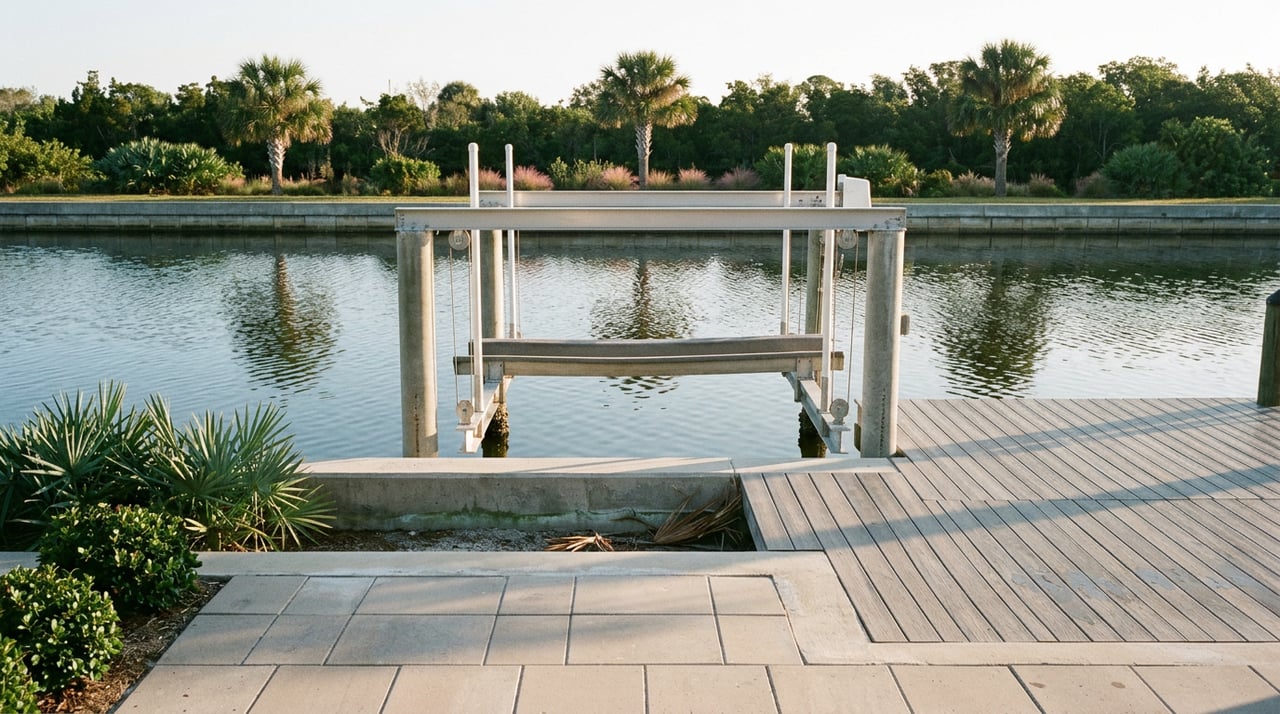
A buyer standing on a dock at Bear Point or looking out over Bayou St. John is thinking about the sunset, the boat, the thirty-second walk from the back porch to the water. What actually decides whether that offer survives to closing rarely has anything to do with the view. It has to do with three or four agencies that have never met each other, a five-year clock on a roof certification most owners forget exists, and a flood policy that may or may not survive the sale of the house it's attached to.
That's the pattern worth understanding before listing or making an offer on a canal-front, bayou-front, or big-water home in Orange Beach: the dock you see is not the transaction. The paper trail behind it is.
The dock has more than one landlord
According to Dock & Decks, the U.S. Army Corps of Engineers oversees construction in navigable waters and enforces environmental regulations, the Alabama Department of Environmental Management regulates water quality and environmental impact, and the Alabama State Lands Division manages construction and land use policies for state-owned waterfronts.
That matters at resale in a specific way. A dock that looks solid, or a bulkhead that looks straight, tells you almost nothing about whether it was ever legally approved. Plenty of waterfront structures on the Alabama Gulf Coast were built by a previous owner, repaired after a storm by a contractor who pulled some permits and not others, or extended without anyone circling back to close the loop with all three agencies. A title search won't catch that. A standard home inspection won't either, since it's evaluating the structure, not its permit history. The gap only shows up when a buyer's attorney or lender asks for documentation and the seller has to go looking for paperwork that may not exist.
The practical takeaway: if you're selling a waterfront home here, gather the dock and bulkhead permit history before you list, not after an offer comes in. If you're buying one, ask for it as part of due diligence, the same way you'd ask about a roof's age.
Insurance isn't one policy. It's three, stacked.
The second place waterfront deals slow down is insurance, and the reason is structural, not seasonal. Bridgeway Insurance says a standard homeowners policy in Baldwin County typically excludes wind. In Baldwin and Mobile counties, most standard insurers exclude windstorm from homeowners policies, so homeowners need separate windstorm coverage; the AIUA writes it when private insurers decline coverage. The Alabama Insurance Underwriting Association is the state-created insurer of last resort for windstorm coverage in coastal Alabama. Flood is a third, entirely separate policy, since flood damage from storm surge or rain accumulation is never covered by homeowners insurance regardless of location.
| Policy | What it actually covers | Who writes it |
|---|---|---|
| Homeowners (HO-3/HO-5) | Fire, theft, liability, and most named perils, with wind commonly excluded by endorsement | Private carrier |
| Windstorm | Wind and hail damage when private insurers decline coverage | Alabama Insurance Underwriting Association (AIUA) |
| Flood | Storm surge and rising water | NFIP or a private flood carrier |
A buyer assuming a waterfront home comes with one tidy insurance bill is usually wrong, and a seller quoting their own premium as a selling point needs to check whether that premium depends on something that doesn't transfer.
That something is often a FORTIFIED Home™ roof designation. Local Property Inc.'s Alabama coastal home insurance guide says FORTIFIED Home™ roof certifications often bring a 20% to 50% reduction on the wind portion of premiums, depending on whether the designation is Bronze, Silver, or Gold. The catch is that the certification isn't permanent. Roof certifications typically need to be renewed every five years to maintain insurance discounts. A seller whose FORTIFIED certification lapsed a few years back may still be enjoying a discounted rate that a new buyer, restarting the underwriting process, won't automatically inherit.
Flood coverage adds its own wrinkle. As of that same 2026 review, Baldwin County includes flood zones X, AE, and VE, and under the current rating system, premiums are now calculated using individual property characteristics, such as distance to water and rebuilding cost, not just elevation, which has made flood insurance more precise but also more variable from one home to the next. As of late 2025, the average NFIP flood policy in Alabama ran near $2,051 a year, and some Baldwin County homeowners had seen their flood premiums jump by more than 100% under the newer rating system. In some cases a buyer can step into a seller's existing flood policy rate, but eligibility depends on the carrier and the property's current risk profile, so it pays to confirm that early rather than assume it late.
The freeboard rule that decides what you can rebuild
The most concrete piece of the puzzle sits with Baldwin County itself, and it applies to any waterfront home that gets built, rebuilt, or substantially improved. The county's floodplain ordinance sets a hard line: no habitable area is allowed below Base Flood Elevation (BFE) plus 1 foot of freeboard. Before a permit is even issued, a Temporary Benchmark or Elevation Certificate is required, and once construction wraps, a Finished Construction Elevation Certificate must be submitted to the Building Department at least 24 hours prior to scheduling a final inspection. That certificate has to be signed and stamped by an Alabama registered design professional, so it's not paperwork a homeowner can generate after the fact with a tape measure.
Here's why that matters for a resale rather than new construction. A buyer looking at an older waterfront home with a newer addition should ask whether that addition has a Finished Construction Elevation Certificate on file with the county. If it doesn't, that's not necessarily a dealbreaker, but it's a conversation to have with a lender and an insurance agent before closing, not after.
What to gather before you list or offer
For sellers, the fastest way to keep a waterfront deal moving is to assemble the paper trail before a buyer's attorney asks for it:
- Permit records for the dock, lift, and bulkhead, including any Army Corps or ADEM correspondence if the work is recent enough to have it on file.
- The FORTIFIED Home™ certification date, if the roof carries one, and whether it's within its five-year window.
- Copies of the current homeowners, windstorm, and flood declarations pages, so a buyer's lender sees the full three-policy picture at once.
- Any Elevation Certificate on file with Baldwin County, particularly for additions or post-storm rebuilds.
For buyers, the same list works as a due diligence checklist, and asking for it during the inspection period beats waiting for the lender to surface gaps at the eleventh hour. Luxury waterfront inspections on Ono Island already run long, often 4 to 6-plus hours, depending on square footage, number of HVAC systems, roof complexity, specialty appliances, waterfront features, and overall property design. Building the permit and insurance questions into that same window, instead of treating them as a separate scramble, keeps the timeline honest from the start.
A few questions worth asking directly
Can a buyer take over the seller's flood insurance rate? Sometimes. Policy assumptions are allowed in some cases, but eligibility comes down to the carrier and the property's current risk rating, so it's worth confirming with an agent before assuming it will carry over.
Does a metal roof automatically qualify for a FORTIFIED discount? No. The roof has to meet specific installation standards and be certified through the FORTIFIED program itself. Material alone doesn't earn the credit.
What is the AIUA, and when do I actually need it? It's Alabama's state-backed wind pool, and it becomes relevant when a private insurer declines to write wind coverage on a property, which is common enough along this stretch of coast that most waterfront owners end up dealing with it at some point.
Waterfront property on the Alabama Gulf Coast rewards patience with its paperwork the same way it rewards patience with a boat. Buyers who ask the right questions early, and sellers who have answers ready, are the ones whose deals actually close on schedule. For a look at current listings and the practical side of buying or selling waterfront property in Orange Beach, or for a sense of what your own home might be worth in today's market, Stacy Burgos Rodgers is a straightforward next call. Let's connect.
This article is general information, not legal, tax or financial advice. Consult a qualified professional about your situation.